
Laser Hair Removal Marketing That Ranks, Gets Cited by AI, and Fills a Multi-Session Book.
The specialist laser hair removal marketing agency for practices that want the Map Pack, the AI citation, and patients who finish all six-to-eight sessions — not a listicle of "ideas" that fills nothing.
Skinspire runs the complete system: laser hair removal SEO, Google Ads, social media, and multi-session email — one specialist plan, engineered for how patients actually research and book energy-based treatments in 2026.
One clinic per market. No 12-month contracts. Aesthetics and wellness only.

Laser hair removal marketing is the discipline of getting a laser hair removal clinic found for high-intent local searches, cited by AI engines like ChatGPT and Google AI Overviews, and then keeping each patient through all six-to-eight sessions of their protocol. The second half is what most agencies miss.
Skinspire is the specialist laser hair removal marketing agency built for that whole arc — acquisition through retention. Local SEO, LHR SEO, Google Ads, social, and multi-session email. Territory exclusivity. One transparent plan.
Laser hair removal marketing is the practice of attracting and retaining laser hair removal patients across every channel a prospect uses to research and book — organic search, the Google Map Pack, AI engines like ChatGPT and Perplexity, paid search, social media, and email.
Because laser hair removal is a six-to-eight-session protocol spaced four to eight weeks apart — not a one-and-done treatment — effective marketing has two distinct jobs: acquire the first consult, then nurture the patient through the full cycle. A complete program combines local SEO (Map Pack, Google Business Profile, citations, reviews), laser hair removal SEO (service pages, body-area pages, schema), Google Ads on high-intent terms, social media (education and objection-handling video), multi-session email nurture, and AI search optimization (AEO, GEO, AIO).
Unlike generic small-business marketing, it sits inside a regulated, energy-based-device category with FDA and FTC advertising rules — which is why "permanent hair removal" is a phrase a specialist never writes.
If you searched laser hair removal marketing, laser hair removal marketing agency, or how to market laser hair removal, you already know the fundamentals. Patients use Google. Patients use AI. Your competitor two suburbs over is running ads. The question that actually matters is what separates a program that fills a multi-session book from one that produces a nice-looking keyword report.
This page is the answer — the specialist playbook we run for every Skinspire laser hair removal client. Local SEO, service-page architecture, AI search optimization, paid, social, the multi-session email engine, schema, compliance, the 90-day onboarding, and the single-plan pricing it costs to do all of it well. Read it end to end and you'll understand laser hair removal marketing better than 90% of the agencies competing for your business.
On this page
- What laser hair removal marketing is
- Why most LHR marketing underperforms
- The channel playbook — 9 channels
- Laser hair removal SEO
- AEO, GEO, AIO — winning AI search
- Social media marketing
- Email and the multi-session engine
- Google Ads, PPC, and offline
- Schema and entity authority
- Advertising compliance (FDA / FTC)
- The 90-day method
- Pricing — one plan
- FAQ
"Every laser hair removal marketing guide on the internet obsesses over getting the first booking. Almost none of them address the number that actually determines whether the clinic survives: how many patients finish the full protocol. That's the game. Acquire the consult, then nurture eight sessions of revenue — marketed as two jobs, run as one system."Thomas Conroy, SEO & Digital Marketing Lead, Skinspire
The reason your marketing isn't filling the book has almost nothing to do with effort.
If you've paid an agency for laser hair removal marketing and watched a year pass without a reliable stream of booked, completing patients, the cause is rarely that nobody did anything. Posts published. Ads ran. Reports populated. What broke was the strategy underneath — and in this category, four structural problems explain almost every underperforming engagement.
Problem 1: marketing the first visit, ignoring the other seven
Laser hair removal is a course of treatment, not a transaction. A patient needs six to eight sessions to reach long-term reduction, and the lifetime value of a single completing patient runs roughly $1,200 to $3,000 or more. Yet most clinics — and most agencies — spend the entire budget acquiring a first consult and then go silent. Patients drift after session two, the protocol never finishes, and the clinic blames "the market." The most expensive leak in laser hair removal marketing isn't the cost per lead; it's the revenue lost when acquired patients don't complete.
Problem 2: the discount death spiral
Because laser hair removal is easy to price-compare, the reflex is to lead with a discount. The Groupon package. The 70%-off flash sale. It fills chairs once, trains the local market to wait for the next coupon, and attracts the least loyal patients in your radius. Discounting is a tool for a specific moment, not a strategy. A clinic that competes only on price has already lost the patients worth keeping.
Problem 3: the generalist template
Most agencies marketing themselves for "laser hair removal marketing" run one content skeleton across every client and swap the city. The same service page. The same three FAQs. In March 2024, Google formalized a spam policy — scaled content abuse — that targets exactly this, and every core update since has tightened enforcement. Templated laser hair removal pages still ranking on legacy authority are doing so on borrowed time. Worse, the salon-and-spa generalists writing this content don't know that "permanent hair removal" is a phrase that can draw regulatory scrutiny.
Problem 4: zero readiness for AI search
The biggest shift in search in a decade — AI Overviews, ChatGPT search, Perplexity, Gemini answering "does laser hurt," "how many sessions do I need," and "laser hair removal cost near me" by synthesizing and citing sources — is happening right now. Almost no laser hair removal marketing agency has done anything operational about it. Their deliverables still optimize for 2022 signals. Those signals still matter; they are no longer sufficient. The clinics being cited by AI in 2026 are the ones whose agency started building for it in 2025.
Generalist / templated LHR marketing
- Budget spent acquiring the first visit, nothing on completion
- Discount-led offers that erode margin and loyalty
- City-swapped template pages at scaled-content-abuse risk
- "Permanent hair removal" claims that invite FTC scrutiny
- Five competing clinics on the same agency roster
- 2022 playbook — no AEO, GEO, or AIO
- Reports that show rankings, not completed protocols
Specialist LHR marketing (Skinspire)
- Acquisition and multi-session retention as one system
- Value-led positioning; discounts used surgically
- Custom service and body-area pages, per clinic, per market
- Long-term-reduction language, FDA/FTC-compliant by default
- One clinic per locked territory — contractually
- 2026 playbook — AEO, GEO, AIO, schema-rich, entity-saturated
- Reporting tied to consults booked and session completion
Want us to audit your current marketing against these four problems?
Free, no card. We'll tell you which structural leaks are showing up in your account — first-visit fixation, discount dependence, templated content, or AI blind spots — and what it would take to fix each. 48-hour turnaround.
The 9 channels of laser hair removal marketing, ranked by ROI.
A complete laser hair removal marketing program runs nine workstreams. They aren't independent — each feeds the others — but they're distinct disciplines with distinct deliverables. Most agencies do three or four well and template the rest. Skinspire runs all nine as default scope.
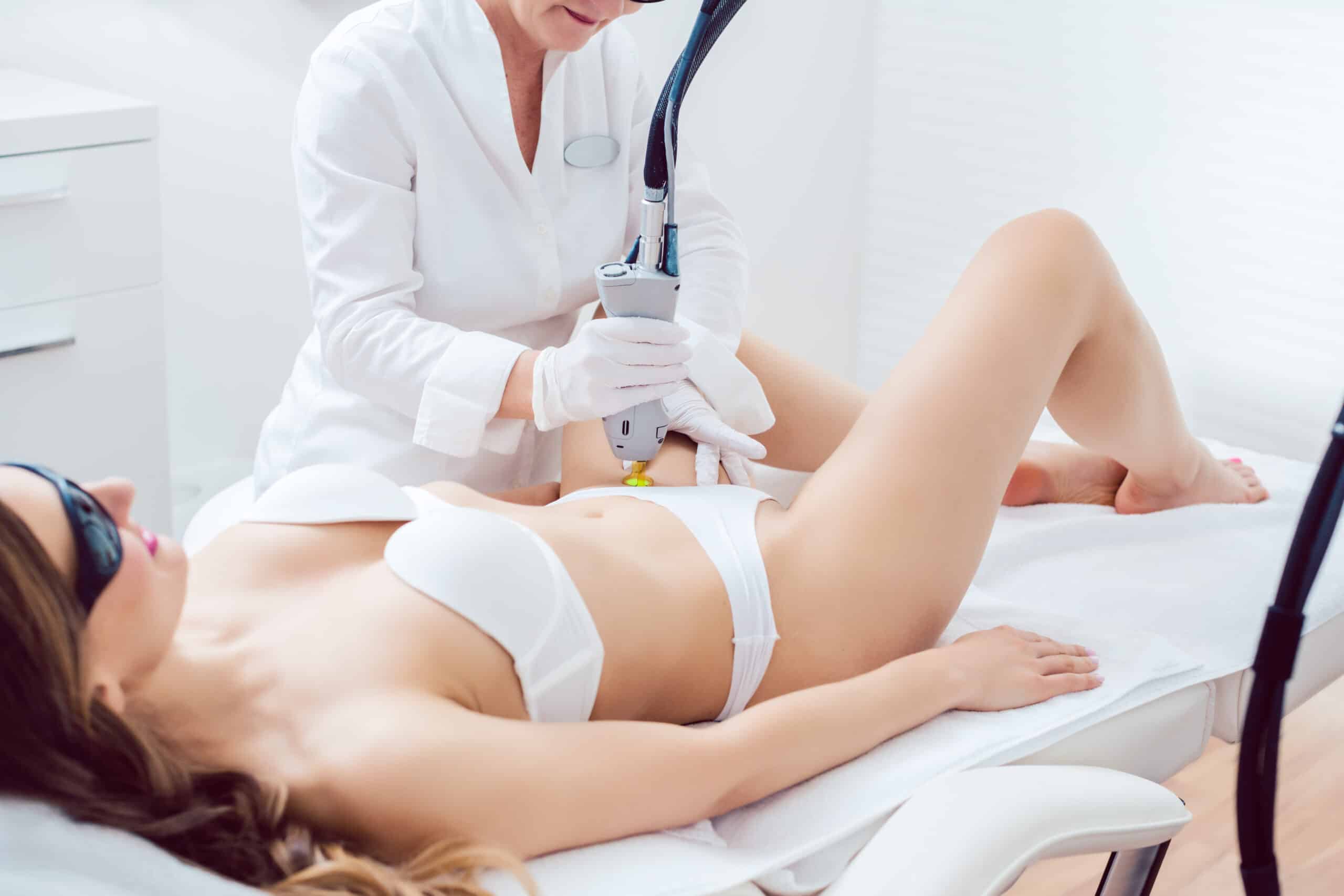
Local SEO & Google Map Pack
For searches like laser hair removal near me and laser hair removal [city], the Map Pack captures roughly 30–45% of clicks — the highest-leverage surface in the category, because a patient wants a provider close to home for a multi-visit protocol. Wins come from primary category selection (Laser Hair Removal Service, Medical Spa), device and treatment-room photos, weekly posts, Q&A seeding, and GBP heatmapping across your radius.
Laser hair removal SEO & service pages
A dedicated laser hair removal service page — plus body-area pages (underarms, Brazilian, legs, back, face) and cost pages — is what ranks. Each is a distinct buyer-intent query with its own SERP, its own AI citation surface, and its own schema. A single "services" page listing laser alongside Botox and facials ranks for none of them.
AI search optimization (AEO, GEO, AIO)
ChatGPT, Perplexity, Gemini, and AI Overviews now answer "does laser hurt," "how many sessions," and "cost near me" by citing sources. Citation is a separate discipline: answer-first passages, named entities (devices, body areas, neighborhoods), citation-worthy statistics, deep schema, and llms.txt. The agencies behind on this hand away citation authority every month they wait.
Email & multi-session nurture
The single highest-leverage retention channel, because laser hair removal is a sequence. Automated email and SMS confirm the booking, deliver pre- and post-care, prompt the next session at the right interval, re-engage lapsed patients, and invite completers into maintenance and referral. This is what protects the full $1,200–$3,000+ lifetime value.
Google Ads & paid search
Paid search fills the book while SEO compounds. High-intent terms — laser hair removal near me, laser hair removal cost [city], laser hair removal deals — carry clear booking intent. Wins come from tightly themed campaigns per body area, dedicated landing pages (never the homepage), call tracking, and negative keywords that filter out at-home-device and "market size" searchers.
Social media marketing
Short-form video on Instagram Reels and TikTok that answers the real questions — pain, session count, skin-tone safety, cost — earns the most reach and the most qualified bookings. Educational content and compliant, consented before-and-afters outperform promotional posts. Paid social then retargets engaged viewers with a booking CTA.
Reviews & reputation
Google reviews influence Map Pack rankings, click-through, on-profile conversion, and AI citation. The bar is volume plus recency plus response. A workflow tied to provider and treatment area — prompting patients to name the body area and city naturally — turns reviews into local relevance signals AI engines parse.
Technical SEO & CRO
Slow site, broken mobile, half-indexed pages — no content fixes that. Technical SEO covers Core Web Vitals, indexability, and llms.txt for AI crawlers. Conversion optimization means click-to-call above the fold, instant-loading before-and-after galleries, online booking, and short forms. In aesthetics, most patients search on mobile — the site has to convert there.
Direct mail & partnerships
Underused and effective in dense residential markets: geo-targeted direct mail to new movers, cross-referral partnerships with gyms, salons, and bridal vendors, and local events. Offline works best when it drives to a tracked landing page and folds into the same nurture engine as every other channel.
"After 20 years in aesthetics, I can tell you the laser hair removal clinics that thrive aren't the ones with the loudest discount. They're the ones a patient finds on Google, sees answered on Instagram, reads about in an AI answer, and then gets a helpful email reminding them their next session is due. That continuity is the whole product. Everything else is a screenshot of a keyword report."Gladys Inting, Founder, Skinspire · 20-year medical aesthetics and wellness industry veteran
If you want to rank for laser hair removal, you need pages built for it.
Laser hair removal SEO is the process of optimizing a clinic's website, Google Business Profile, and content so it ranks for treatment-specific and local searches like laser hair removal near me, laser hair removal [city], laser hair removal cost, and body-area terms such as Brazilian laser hair removal or underarm laser hair removal. It combines local SEO (Map Pack, GBP, citations, reviews), on-page SEO (a dedicated service page plus body-area and cost pages, schema, internal linking), technical SEO (Core Web Vitals, indexability), and authority building — and, increasingly, AI search optimization so the clinic is cited by ChatGPT, Perplexity, and Google AI Overviews.
Most laser hair removal websites have one of two losing architectures: a single "services" page with a paragraph on laser buried among ten other treatments, or a thin 250-word laser page with three FAQs. The first ranks for nothing. The second gets out-published and out-cited by any clinic running deeper, schema-rich, entity-saturated content built for both human readers and AI engines.
The service-page architecture that wins
Every Skinspire laser hair removal page follows a structure designed for the dual mandate of ranking and citation, in this order:
- H1 + direct-answer block in the first 60–100 words — a bolded question and a two-to-three-sentence answer AI engines can lift as a standalone passage.
- Provider attribution early — the named clinician or laser technician with credentials, reinforced with Person and MedicalBusiness schema. Trust matters more for an energy-based device than for a facial.
- Body-area coverage and dedicated pages — underarms, bikini/Brazilian, legs, back, chest, face, full body. Each has its own search volume, its own pricing, and its own FAQ.
- Named-entity saturation — device and technology names (diode, Alexandrite, Nd:YAG, IPL, and specific platforms like GentleMax Pro, Soprano ICE, or Motus AY), skin-type language (Fitzpatrick I–VI), and local neighborhoods and landmarks. AI engines weight entity frequency heavily.
- Cost and comparison content — honest price ranges by area and package, laser vs waxing vs electrolysis, and "how many sessions" — the exact questions patients ask before booking, which is exactly what AI engines cite.
- Compliant claims — "long-term hair reduction," never "permanent hair removal," with before-and-after images backed by documented consent and honest typical-results context.
- Schema stack — MedicalProcedure or Service, Person for the provider, FAQPage, Review, BreadcrumbList, and SpeakableSpecification on the answer block.
- CTAs at every content break — click-to-call, online booking, and a free-consultation form. The architecture is built for a booked consult, not just a ranking.
The laser hair removal keyword map
Ranking follows intent. A specialist maps the clinic's pages to the way patients actually search — from awareness to booking — rather than chasing one head term.
| Intent stage | Representative searches | Page that should rank |
|---|---|---|
| Local / booking | laser hair removal near me; laser hair removal [city]; laser hair removal deals [city] | Main service page + Google Business Profile + city pages |
| Body-area | Brazilian laser hair removal; underarm laser hair removal; full body laser hair removal | Dedicated body-area pages |
| Cost / comparison | laser hair removal cost; laser hair removal price [city]; laser vs waxing; laser vs electrolysis | Cost guide + comparison content |
| Consideration | does laser hair removal hurt; how many sessions; is it safe for dark skin; laser hair removal aftercare | FAQ blocks + educational blog cluster (AI-citation targets) |
| Audience | men's laser hair removal; laser hair removal for PCOS; laser hair removal for [skin type] | Segment pages for underserved audiences |
For a typical single-location clinic in a moderately competitive market, the production target is one strong main service page, 5–8 body-area pages, 2–4 city or neighborhood pages, a cost guide, two comparison pages, and an ongoing educational blog cluster — a 15-to-25-page indexable footprint built for both Google and AI engines. Anything thinner is being out-published every month.
The laser clinics being cited by AI in 2026 are the ones whose agency started in 2025.
AI search engines — ChatGPT, Perplexity, Gemini, and Google's AI Overviews — answer a fast-growing share of laser hair removal questions by synthesizing and citing sources rather than returning ten blue links. "Does laser hurt," "how many sessions," "is it safe for my skin tone," "laser hair removal cost near me" — these are exactly the queries AI now handles. Being the source those answers cite is a separate discipline from traditional SEO, and right now it's the most valuable arbitrage in aesthetics marketing.
AEO = Answer Engine Optimization. GEO = Generative Engine Optimization. AIO = AI Overviews Optimization. Together they describe producing content that gets cited by name in AI-generated answers, rather than (or in addition to) ranking on traditional SERPs.
A 2026 specialist laser hair removal marketing agency operationalizes all three. Most agencies still treat them as a future upsell.
How AI search cites sources differently than Google ranks pages
Traditional SEO optimizes whole pages to rank against competing pages on a SERP. AEO and GEO optimize passages within a page to be cited by an LLM synthesizing an answer. The tactics overlap, but the differences are measurable and specific.
| Signal | Traditional SEO weighting | AI search weighting |
|---|---|---|
| Content structure | Long pages with keyword-rich headers | Answer-first paragraphs — bolded question + a direct two-to-four-sentence answer extractable on its own |
| Passage optimization | Whole-page relevance | Self-contained passages that read correctly out of context, since LLMs cite the chunk, not the page |
| Entity signals | Keyword density | Named-entity saturation — specific devices, body areas, skin types, neighborhoods, clinicians |
| Schema deployment | LocalBusiness, FAQPage when remembered | Deep stack — MedicalBusiness, MedicalProcedure, Person, Service, Review, SpeakableSpecification |
| Statistics & claims | Benefit-oriented prose | Specific, attributable numbers — session counts, cost ranges, timelines — cited over vague claims |
| Machine readability | robots.txt, XML sitemaps | llms.txt and llms-full.txt — the emerging AI-crawler standard most laser clinics haven't deployed |
The tactics that move AI citation rate for a laser clinic
- Answer-first formatting on every page. H1, then a bolded question and a 60–120-word direct answer inside a styled block with SpeakableSpecification schema pointed at it. That block is what AI engines lift.
- Passage optimization. Every paragraph reads correctly in isolation — no dangling references to the prior section. LLMs cite chunks, not pages.
- Named-entity saturation. Devices (diode, Alexandrite, Nd:YAG, IPL), platforms (GentleMax Pro, Soprano ICE, Motus AY), skin types (Fitzpatrick I–VI), body areas, and neighborhoods, used specifically and repeatedly.
- Citation-worthy statistics. "Long-term reduction typically takes six to eight sessions spaced four to eight weeks apart" is far more citable than "laser works great." Concrete numbers get cited; opinions don't.
- Deep schema deployment. The full stack on every relevant page — how LLMs parse who you are, what you treat, and who delivers it.
- llms.txt and llms-full.txt. A clean Markdown summary of the clinic AI crawlers can index efficiently. Virtually no competing laser hair removal agency ships this yet, which is exactly why we do.
- Editorial citation targeting. Mentions in local press and aesthetics publications — weighted by LLMs as a trust signal separate from traditional link equity.
"AI search is the first shift in a decade the scaled-content model can't quietly absorb. Every prior update could be patched by updating templates. Citation by ChatGPT can't be templated — which is exactly why template-built agencies are structurally locked out of it. The laser clinics optimizing for AEO and GEO now are inheriting citation authority that will be very expensive to displace 18 months from now."Thomas Conroy, SEO & Digital Marketing Lead, Skinspire
If your current agency can't show you a deliverable from the last 30 days with a SpeakableSpecification block, a deployed llms.txt file, or a content brief that names specific devices, body areas, and citation-worthy statistics by design — they aren't operationalizing AI search. They're talking about it.
Laser hair removal is a sequence. Your marketing has to be one too.
Email is the single highest-leverage retention channel for laser hair removal because the treatment is a six-to-eight-session protocol spaced four to eight weeks apart. A well-built automated sequence confirms the first booking, delivers pre- and post-care instructions, prompts the next session at the right interval, re-engages patients who lapse between sessions, and invites completed patients into maintenance and referral. That multi-session nurture is what protects the full lifetime value of each patient — often $1,200 to $3,000 or more — instead of losing them after visit one or two. Seasonal campaigns and package offers layer on top of the core sequence.
Here is the number that reframes laser hair removal marketing: a single completing patient is worth $1,200 to $3,000 or more across their protocol, but a clinic that acquires the first visit and goes silent typically captures only a fraction of that. The gap between those two outcomes is not a bigger ad budget — it's an automated nurture sequence. Email and SMS are where laser hair removal marketing quietly makes or loses most of its money.
The multi-session nurture sequence, stage by stage
- Booking confirmation & prep. Immediate confirmation, what to expect, and pre-treatment instructions (avoid sun, no waxing or plucking, shave the area). Sets the patient up to succeed on session one.
- Post-care & reassurance. After each visit, aftercare guidance and gentle reassurance that redness and shedding are normal — reducing anxiety-driven drop-off.
- Next-session prompt at the right interval. Automated reminders timed to the four-to-eight-week cadence, with one-tap rebooking. The single biggest lever on completion rate.
- Lapsed-patient re-engagement. If a patient misses their window, a re-engagement flow explains why consistent spacing matters for results and makes it easy to get back on schedule.
- Completion, maintenance & referral. After the final session, an invitation into annual maintenance touch-ups and a referral ask — the point at which lifetime value compounds.
- Seasonal & cross-treatment campaigns. On top of the core flow, seasonal offers (fall is the ideal start window) and thoughtful cross-sells to other services the patient now trusts you for.
Done well, this runs on autopilot inside a booking platform such as Boulevard, Vagaro, or a connected CRM — every message tied to the patient's actual treatment stage and body area. It's unglamorous. It's also where the difference between a busy clinic and a profitable one usually lives.
Paid search fills the book while SEO compounds.
Yes — Google Ads is the fastest way to capture patients actively searching to book, and it's most valuable in the first months while SEO is still compounding. High-intent terms like laser hair removal near me, laser hair removal cost [city], and laser hair removal deals signal a patient comparing providers right now. The keys to profitability are tightly themed campaigns (ideally per body area), dedicated landing pages rather than the homepage, call tracking, and disciplined negative keywords that filter out at-home-device shoppers, "market size" researchers, and job seekers. Send the click to a page built to convert, not to a generic services page.
Two disciplines separate a profitable laser hair removal ad account from a money furnace. First, match the landing page to the search — someone searching "Brazilian laser hair removal cost [city]" should land on a page about exactly that, with the price range and a booking button visible without scrolling. Second, track to the consult, not the click — call tracking and form attribution tell you which keywords produce booked patients, so budget flows to what actually fills the book.
Where the budget actually belongs
| Channel | Best for | Realistic time to traction |
|---|---|---|
| Google Search Ads | Capturing high-intent "near me" and cost searches immediately | 2–4 weeks |
| Local SEO + Map Pack | Durable, compounding organic lead flow | 60–120 days |
| Meta (paid social) retargeting | Converting people who watched your educational video | 2–6 weeks |
| Email / SMS nurture | Session completion and lifetime value | 1–3 weeks |
| Direct mail (new movers) | Dense residential markets, brand-new local presence | 3–8 weeks |
| Local partnerships | Gyms, salons, bridal, wellness cross-referrals | 4–10 weeks |
Direct mail and offline still earn their place in the right market. Geo-targeted new-mover mail, cross-referral partnerships with gyms, salons, and bridal vendors, and small in-clinic events all work — but only when they drive to a tracked landing page and feed the same nurture engine as every digital channel. Offline that dead-ends at "call us" leaks most of its return. Offline that routes into your CRM compounds with everything else.
Schema is how Google and AI engines parse your laser clinic.
A complete laser hair removal schema stack includes MedicalBusiness or LocalBusiness, MedicalProcedure or Service for the treatment (with alternateName coverage for laser hair removal, LHR, and body-area variants), Person for each provider, FAQPage matched to the visible FAQ, Review and AggregateRating for testimonials, BreadcrumbList for hierarchy, and SpeakableSpecification on answer blocks. Most laser hair removal sites have only LocalBusiness — or no schema at all. The gap shows up in Map Pack rankings, rich-result eligibility, and AI citation rates.
Schema is the structured-data layer that tells Google, Bing, and large language models exactly what your page is about. It's the connective tissue between your content and the systems deciding what gets surfaced and cited. A laser clinic with deep schema shows up in AI Overviews, knowledge panels, FAQ-rich results, and ChatGPT citations far out of proportion to its raw backlink profile.
| Schema type | Where to deploy | What it earns you |
|---|---|---|
| MedicalBusiness / LocalBusiness | Home, about, location pages | Knowledge-panel eligibility, Map Pack signal, AI entity recognition |
| MedicalProcedure / Service | Main and body-area laser pages | Rich-result eligibility, AI Overview citation, deeper entity association |
| Service (alternateName) | Laser service pages | Captures variants — laser hair removal, LHR, Brazilian laser — mapped to one entity |
| Person | Provider bios, attribution on pages | E-E-A-T signals, AI citation of the clinician by name |
| FAQPage | Wraps the visible FAQ on every page | FAQ rich results, People Also Ask, AI answer extraction |
| Review & AggregateRating | Pages with first-party testimonials | Star ratings in SERP, trust signals for AI citation |
| SpeakableSpecification | On the WebPage @id, pointed at answer blocks | Voice-search and AI extraction priority |
Entity authority is the durable moat. It means getting search engines and LLMs to recognize your clinic, your providers, your treatments, and your service area as named entities with specific relationships — built on-site (schema, consistent NAP, provider bios, entity saturation), off-site (citations, editorial mentions, structured profiles on Healthgrades, RealSelf, Yelp, Apple Maps), and eventually in the knowledge graph. Backlinks can be replicated; content can be out-published; an established entity is far harder to displace — and entity status is what AI engines actually weigh when they decide whom to cite.
The claim a specialist never makes: "permanent hair removal."
No — that phrasing carries real regulatory risk. In the United States, most laser and IPL devices are cleared for "permanent hair reduction," not "permanent hair removal," and the FTC holds aesthetic advertisers to a high substantiation standard. Compliant marketing uses language like "long-term hair reduction" or "lasting smooth skin," presents before-and-after images with documented consent and honest typical-results context, and avoids guarantees. A specialist laser hair removal marketing agency builds this into every service page, ad, and social post by default — because one misleading claim can undo an entire campaign.
This is where generalist salon and small-business marketers quietly expose their clients. Energy-based device marketing sits under FDA device-clearance language and FTC truth-in-advertising standards that most agencies have never read. The specifics that matter for laser hair removal:
- "Reduction," not "removal." Device clearances describe long-term hair reduction. Marketing that promises permanent removal overstates the clearance and invites scrutiny.
- Before-and-after honesty. Images need documented, specific consent, and results should be presented as typical rather than guaranteed. Cherry-picked, undisclosed, or filtered results are an FTC exposure.
- No guarantees, no absolutes. Results vary by skin type, hair color, hormones, and body area. Copy that guarantees outcomes for "everyone" is both inaccurate and risky.
- Substantiation for every claim. "Painless," "FDA-approved," "works on all skin tones" — each needs to be accurate and supportable. "FDA-cleared" and "FDA-approved" are not interchangeable.
- Testimonials and reviews. Incentivized reviews must be disclosed; fabricated ones are illegal. This is a growing FTC enforcement area.
Compliance isn't a constraint on good laser hair removal marketing — it's a competitive advantage. The honest, specific, well-substantiated clinic reads as more credible to patients and to the AI engines that increasingly weigh trustworthiness when deciding whom to cite. Overpromising is how you win a booking and lose the trust that fuels the next seven sessions.
The 90-day onboarding — from generic visibility to Map Pack, AI citations, and a nurtured book.
Skinspire's onboarding is a specific 90-day sequence that builds the foundation before content compounds. The order matters. Skipping to "post more Reels" before the technical foundation, schema, GBP, and nurture engine are built is what most agencies do — and why most laser hair removal marketing underperforms.
Full audit baseline
Technical SEO audit, Google Business Profile audit, content audit, backlink audit, competitor SERP analysis for every laser hair removal query, and an AI citation baseline across ChatGPT, Perplexity, Gemini, and Google AI Overviews. Output: a written audit and a 90-day priority queue.
Technical remediation
Core Web Vitals fixes, mobile usability, crawl-error cleanup, robots and sitemap hygiene, internal linking, and deployment of llms.txt and llms-full.txt for AI-crawler readiness — the unglamorous work that determines whether every later channel performs.
Schema deployment
The full stack — MedicalBusiness, MedicalProcedure, Service, Person, FAQPage, Review, BreadcrumbList, SpeakableSpecification — validated via Google's Rich Results Test and matched to visible content, with long-term-reduction-compliant language throughout.
Google Business Profile buildout
Category and service selection, laser hair removal service listing, attributes, a full photo set (device, treatment rooms, team, consented before-and-afters), weekly posts, Q&A seeding for the top patient questions, review-request workflow live, and GBP heatmapping across the protected radius.
Service & body-area pages
The main laser hair removal page plus priority body-area and cost pages, rebuilt with answer-first structure, named-entity saturation, 8–12-question FAQs, provider attribution, MedicalProcedure schema, and citation-worthy statistics. Where ranking and AI citation start moving.
Citations & earned authority
Citation cleanup across 40+ aesthetics-relevant directories with a NAP-consistency audit, then activation of the clinic's existing relationships — device-manufacturer affiliations, press history, local partnerships, community involvement. No cold outreach, no purchased placements, no guest-post packages.
Content & social live
First wave of 4 blogs per month plus 10 content credits — treatment guides, cost-and-comparison content, body-area pages, and educational social content engineered for AI citation and reach. Every piece briefed against entity, citation, and schema targets.
Multi-session nurture & reviews
Automated email and SMS nurture tied to the six-to-eight-session cadence — booking confirmation, pre/post-care, next-session prompts, lapsed re-engagement, completion and referral — plus a review-request flow tied to provider and treatment area. The retention system most clinics never build.
Strategic recalibration
Full-funnel reporting — Map Pack movement, organic traffic, AI citations, consults booked, session-completion rate, and revenue attributed. Recalibration for the next 90 days. Onboarding is over; the engagement is now month-to-month.
Want to see what the audit would say about your clinic?
Free audit. No card. Real findings — Map Pack gaps, technical issues, schema deployment, AI citation baseline, and a written priority queue.
One plan. Everything you need. Nothing you don't.
We used to sell four tiers. We killed them. Tiered pricing is how agencies upsell people into things they don't need. Here is the only laser hair removal marketing plan we offer — the one that actually fills a multi-session book — at a price that lets us do the work properly without locking you into a 12-month contract.
The Skinspire LHR Marketing Plan
- Up to 20-mile exclusive territory
- Month-to-month after 90-day onboarding
- Dedicated account strategist
- 4 blogs / month (written by aesthetic-trained humans)
- 10 content credits / month (new pages or re-optimization)
- Google Business Profile + 4 monthly updates
- GBP heatmapping across your service radius
- Full schema deployment (MedicalBusiness, MedicalProcedure, FAQPage, Person, Review)
- AI search optimization — AIO, AEO, GEO
- llms.txt and llms-full.txt deployment
- Body-area & cost page architecture
- Citation cleanup + 40+ directory footprint
- Review generation workflow (provider + area specific)
- Multi-session email/SMS nurture setup
- Monthly technical SEO audit
- Conversion tracking — calls, forms, bookings
- Monthly strategy call with your actual strategist
- ROI reporting tied to consults + session completion
- No 12-month contract — 30 days' notice to cancel
Why $1,450 — and why we don't sell anything cheaper
Below this price point, the math forces a content mill, a 40-client-per-strategist load, and a templated playbook. Above it, you're paying agency overhead, not work. We picked the price that lets a specialist team produce real service-page content, run real technical SEO, build real authority, set up the multi-session nurture engine, and operationalize AI search — for a clinic whose territory we've locked.
The other math worth knowing: a completing laser hair removal patient is worth $1,200 to $3,000 or more across their protocol. Two additional completing patients per month from organic and AI search covers the $1,450 retainer several times over — before you count the referrals and maintenance visits the nurture engine produces. The economics aren't subtle. Most clinics don't see them because most agencies aren't producing completing patients in the first place.
What you're actually buying when you hire a specialist laser hair removal marketing agency.
Any single one of the nine channels on this page is something a generalist can do passably for a quarter. Running all nine in the right sequence — with territory exclusivity, multi-session nurture, and AI search as default scope — is what separates a specialist laser hair removal marketing agency from a vendor.
Aesthetics and wellness only
Skinspire doesn't moonlight on HVAC accounts or law firms. We work with medical aesthetics, laser and energy-based device clinics, plastic surgery, dermatology, weight loss, and wellness — one industry.
One clinic per territory
Territory exclusivity is a contractual commitment, not a marketing claim. Once you onboard, no competing laser clinic in your protected radius can buy us out of position against you.
Multi-session nurture, built in
Acquisition and completion as one system. The email and SMS engine that carries patients through all six-to-eight sessions is default scope — not an upsell.
AI search, default
AEO, GEO, AIO, llms.txt, deep schema, entity saturation — the 2026 AI search stack is included on every engagement at no upcharge.
About the authors.
Every month you wait, a competitor locks in your territory.
Once a competing laser clinic locks in your market with Skinspire, we can't take you on. The free audit takes 48 hours and tells you exactly where you stand — Map Pack, AI citations, technical, schema, nurture gaps, and what it would take to own your market.
The questions clinic owners ask before they sign — answered directly.
What is laser hair removal marketing?
Laser hair removal marketing is the discipline of attracting and retaining laser hair removal patients across every channel a prospect uses to research and book — organic search, the Google Map Pack, AI engines like ChatGPT and Perplexity, paid search, social media, and email. Because laser hair removal is a six-to-eight-session protocol rather than a one-time treatment, effective marketing has two jobs: acquire the first consult, then nurture the patient through the full cycle. It combines local SEO, treatment-page and body-area content, Google Business Profile optimization, Google Ads, social media, multi-session email nurture, review generation, and increasingly AI search optimization (AEO, GEO, AIO).
How much does laser hair removal marketing cost?
Laser hair removal marketing typically costs between $500 and $5,000 per month in 2026, depending on scope. Below $1,000/month, the work is usually templated content and citation submissions handled by junior or offshore teams. Between $1,400 and $3,000/month is the band where specialist agencies produce custom treatment-page content, run real technical SEO and Google Business Profile optimization, and operationalize AI search. Above $3,000/month typically adds significant paid-ad spend, custom reporting, and multi-location coverage.
Skinspire's single plan is $1,450/month plus a $999 one-time start-up fee, month-to-month after a 90-day onboarding. Google Ads spend, when used, is separate and paid directly to Google.
What is the best marketing strategy for a laser hair removal clinic?
The highest-ROI strategy for most clinics is local SEO plus the Google Map Pack, because patients want a provider near home for a multi-visit protocol and the Map Pack captures roughly 30 to 45 percent of clicks on local treatment searches. Google Ads fills demand while SEO compounds. But the single strategy that separates winners in 2026 is a multi-session nurture engine: laser hair removal patients are worth $1,200 to $3,000 or more across a full cycle, and clinics that automate email and SMS follow-up through all six to eight sessions dramatically outperform clinics that acquire a first visit and then go silent. The best clinics run acquisition and retention as one system.
How do I get more laser hair removal clients?
Own the searches patients actually run: build a dedicated laser hair removal service page and body-area pages optimized for "laser hair removal near me" and "laser hair removal [city]," fully optimize your Google Business Profile, and get cited in AI engines with answer-first content. Layer Google Ads on high-intent terms to capture demand immediately, run educational social content that handles the pain, cost, and skin-tone objections, and — most importantly — automate a multi-session follow-up sequence so first-time patients complete their full protocol and refer others. The compounding win comes from combining first-visit acquisition with disciplined multi-session retention.
Is SEO worth it for a laser hair removal clinic?
Yes. Laser hair removal is a high-consideration, local, high-lifetime-value service — exactly the profile where SEO produces the strongest return. A patient acquired through organic search costs nothing per click once the content exists, and a single completing patient is worth $1,200 to $3,000 or more. Most clinics see measurable Map Pack and ranking movement within 60 to 90 days of a properly built foundation, with booking impact compounding from the four-to-six-month mark as service pages mature and reviews accumulate.
What is the target market for laser hair removal?
The core target market skews toward adults aged roughly 19 to 50, with industry data historically showing the large majority of procedures in that band, and a client base that is majority women but with a fast-growing male segment. In practice, a clinic's most valuable targets are local, higher-intent researchers comparing providers within driving distance for a multi-visit protocol — people searching "laser hair removal near me," "laser hair removal cost," and body-area terms like underarms, Brazilian, legs, back, and face. Effective targeting segments by body area, gender, and price sensitivity rather than treating "everyone who wants smooth skin" as one audience.
How do I market laser hair removal on social media?
The top-performing strategy leads with education and objection-handling, not discounts. Short-form video on Instagram Reels and TikTok answering real questions — does it hurt, how many sessions, is it safe for my skin tone, what does it cost — earns the most reach and the most qualified bookings. Compliant before-and-after content with documented consent, a named clinician on camera for trust, and a consistent posting cadence outperform occasional promotional posts. Paid social on Meta then retargets engaged viewers with a clear booking CTA. Never claim "permanent hair removal"; use "long-term hair reduction" to stay within FDA and FTC standards.
How does email marketing work for a laser hair removal clinic?
Email is the single highest-leverage retention channel because the treatment is a six-to-eight-session protocol spaced four to eight weeks apart. A well-built sequence confirms the first booking, delivers pre- and post-care instructions, prompts the next session at the right interval, re-engages patients who lapse between sessions, and invites completed patients into maintenance and referral. That automated multi-session nurture protects the full lifetime value of each patient — often $1,200 to $3,000 or more — instead of losing them after visit one or two. Seasonal campaigns and package offers layer on top of the core sequence.
Can I advertise "permanent hair removal" for laser treatments?
No — that phrasing carries real regulatory risk. In the United States, most laser and IPL devices are cleared for "permanent hair reduction," not "permanent hair removal," and the FTC holds aesthetic advertisers to a high substantiation standard. Compliant marketing uses language like "long-term hair reduction" or "lasting smooth skin," presents before-and-after images with documented consent and honest typical-results context, and avoids guarantees. A specialist agency builds this compliance into every service page, ad, and social post by default, because one misleading claim can undo an entire campaign.
How long does laser hair removal SEO take to work?
Most laser hair removal clinics see measurable ranking and Map Pack movement within 60 to 90 days of a properly built foundation. Booking-volume impact typically arrives at the four-to-six-month mark as service pages mature, reviews accumulate, and authority compounds. Laser hair removal SEO follows a compounding curve, not a paid-ads curve — the clinic ranking position three at month four is usually in the Map Pack by month nine.
Do I need a laser hair removal marketing agency, or can I do it in-house?
A clinic with a dedicated marketing lead can run Google Business Profile, review generation, social posting, and basic email in-house. The pieces that almost always fail in-house are technical SEO, schema architecture, service-page content at scale, Google Ads management, AI search optimization, and advertising compliance for energy-based devices. A common hybrid is in-house social and reviews plus a specialist agency handling SEO, technical, paid, and AEO/GEO. The deciding factor is usually whether the practice can produce compliant, differentiated content consistently — most cannot, which is why specialist agencies exist.
Does Skinspire offer laser hair removal marketing outside Tampa, and is there a contract?
Yes. Skinspire is headquartered in Tampa, Florida, and works with laser hair removal clinics and med spas nationwide. Every engagement is territory-locked — one clinic per protected radius — so the practical question is whether a competitor has already claimed your market. There are no 12-month contracts. The only commitment is a 90-day onboarding window to build the foundation; after that the engagement is month-to-month with 30 days' written notice to cancel. Single-plan pricing and the 90-day onboarding are identical nationwide.
You've read the whole playbook. Want to see it run on your clinic?
If you scrolled through 9,000 words on laser hair removal marketing, you're not casually shopping — you're diligencing. The free audit is the next step. We'll run the same framework on your domain, GBP, schema, AI citation baseline, nurture gaps, and competitive landscape that we run on every Skinspire client during the first 7 days of onboarding. 48-hour turnaround. No card, no obligation, no sales call until you ask for one.
The top-performing laser hair removal social strategy leads with education, not discounts.
The highest-performing laser hair removal social media strategy leads with education and objection-handling — not promotions. Short-form video on Instagram Reels and TikTok that answers real patient questions (does it hurt, how many sessions, is it safe for my skin tone, what does it cost) earns the most reach and the most qualified bookings. Compliant before-and-after content with documented consent, a named clinician on camera for trust, and a consistent posting cadence outperform occasional promotional posts. Paid social on Meta then retargets engaged viewers with a clear booking CTA. Never claim "permanent hair removal"; use "long-term hair reduction" to stay within FDA and FTC standards.
What actually performs, by platform
The mistake nearly every clinic makes is posting only when there's a promotion. Social media rewards consistent educational value; the booking comes later, from the patient who watched three of your Reels, trusted the clinician, and searched your name. Discount posts are a small seasoning on top of an education-led feed — never the whole meal.